· Indian Ocean · 4 min read
15-Day Cruise Chain: Cape Town → Dubai
How to combine multiple cruises from Cape Town to Dubai into one continuous journey using compatible routes and ports.
Intro
This itinerary works as a connected chain rather than a single-product voyage. The 15-day Cape Town-to-Dubai profile is built for route continuity, not brand continuity, which means the value comes from compatible handoff design and realistic transfer flow.
Travelers frequently search this as the “Cape Town to Dubai cruise chain” because it connects indian ocean ports through one practical handoff structure.
travelers comparing southern Africa and Arabian hub ports in a single itinerary framework. The chain is best suited for travelers who prefer broad regional coverage and can keep dates flexible by a few days. That flexibility matters because adjacent itineraries rarely align perfectly on every cycle, especially when weather or port rotation changes arrival order.
Route Overview
A common route order is:
- Cape Town
- Port Elizabeth/Gqeberha
- Durban
- Mauritius
- Muscat
- Dubai
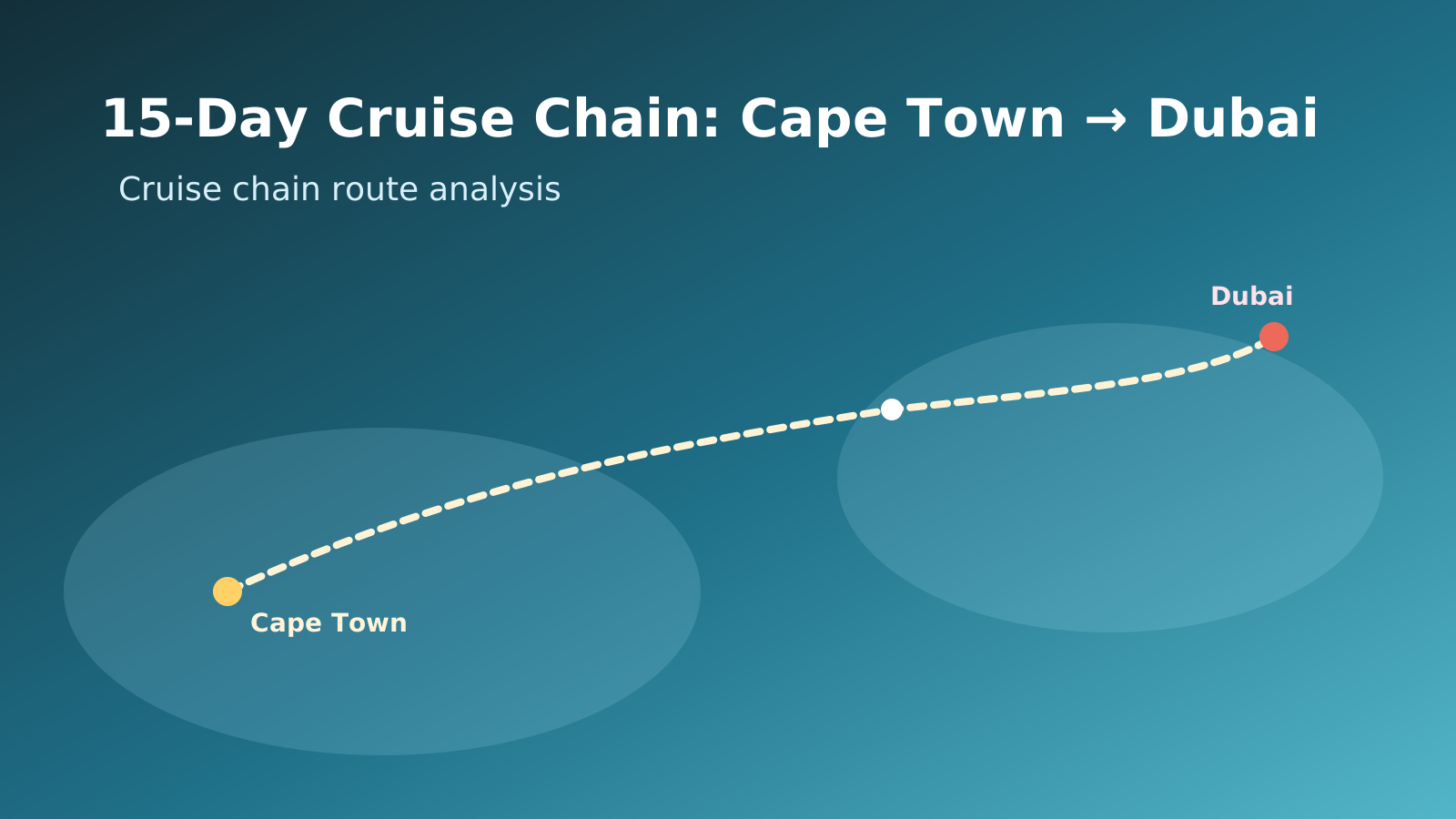
This order can vary without breaking the route logic. Some operators swap one or two calls while keeping the same start, connection port, and endpoint. For planning purposes, the most important element is that both segments repeatedly touch Mauritius, where transfer logistics are practical and schedules are comparable.
Why It Works
This route holds together because both legs align with recurring calendar patterns rather than one-off movements. In this chain, Mauritius acts as the compatibility anchor because it appears in both segment ecosystems and supports independent disembarkation and embarkation operations.
For this route, compatibility depends on handoff operations, not map proximity alone; predictable pier assignment and transfer timing are the deciding factors. When those elements are present, cross-line chaining becomes materially easier.
Keeping transfer dates open by a few days materially improves matching options and lowers risk from minor arrival shifts.
Segments
Segment 1: Cape Town to Mauritius (about 6-8 nights)
The Africa-side leg combines southern coastal calls with a stable operational build toward Indian Ocean midpoints. This segment usually defines the operational pace of the overall chain and determines how conservative the handoff buffer should be.
Compatibility checks for segment 1:
- Arrival timing into Mauritius that leaves transfer margin.
- Clear terminal procedures and predictable passenger flow.
- Calendar repeatability that allows alternate pairing if needed.
Segment 2: Mauritius to Dubai (about 6-9 nights)
From island handoff, the route continues through Arabian Sea pathways into UAE turnaround ports. The second segment provides the route’s destination character and sets final disembarkation context at Dubai.
Compatibility checks for segment 2:
- Departure window that can absorb minor first-leg variation.
- Port sequence that adds regional contrast instead of duplication.
- Final port operations aligned with onward travel logistics.
Availability
This chain is most workable in southern hemisphere shoulder seasons and cooler Gulf months. Availability depends on overlapping deployment seasons, so broad timing ranges perform better than fixed-day assumptions.
Outside peak overlap seasons, the chain remains possible but with fewer pairings; a range-based approach is usually more reliable than single-date targeting.
Context
In the broader cruise landscape, this itinerary sits as an inter-regional chain linking African coastal deployment with Middle East cruise networks. It is effectively a connector format: longer than a short single-basin trip, but more modular than a continuous grand voyage.
Compared with a single-route product, chaining expands geographic coverage; compared with extended one-ship voyages, it is easier to re-pair segments when calendars shift.
FAQ
Why is Mauritius the main connection point in this route?
Because both route legs cycle through this port frequently, and terminal logistics are built for embark/disembark turnover.
Is an overnight stay usually needed between the two segments?
Same-day transfer is possible in narrow timing windows; a small buffer is the safer default.
Can the two segments come from different operators?
No. Staying with one line is optional; what matters is the compatibility of schedules and transfer logistics.
Who is this route best suited for?
travelers comparing southern Africa and Arabian hub ports in a single itinerary framework, especially those who value schedule flexibility and destination range.